
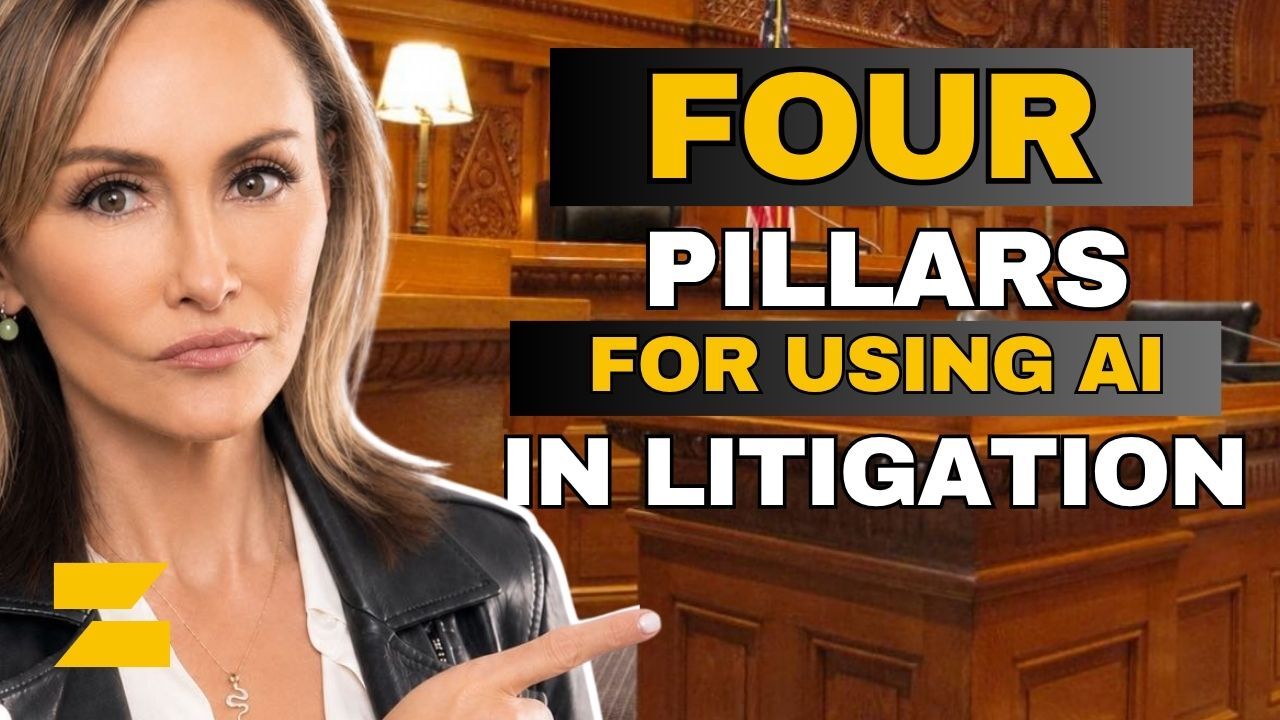
Four Pillars for Using AI in Litigation Without Getting Sanctioned
Mata v. Avianca was not an anomaly. Treating it as a one-off embarrassment rather than a warning is the mistake I see lawyers making right now, and it's the mistake that's going to keep producing sanctions orders for the next several years.
For anyone who missed it: an attorney used AI to draft a brief and submitted it with citations to cases that didn't exist. The AI fabricated them. They had real-sounding names, real-sounding holdings, and none of it was true. The court sanctioned the attorney, but more importantly, it used the ruling to make a broader statement about professional responsibility. The tool doesn't absorb your obligations. You do.
AI in litigation isn't going away, and it shouldn't. Used correctly, it's the closest thing to a force multiplier this profession has seen since e-discovery. Used carelessly, it's a liability with your name and bar number attached. The difference between the two comes down to four pillars.
Pillar 1: AI-generated drafts
Treat every AI draft the way you'd treat work from a fast, confident, unreliable junior associate — because that's exactly what it is. It writes beautifully. It also gets case citations wrong, misapplies holdings, and doesn't know whether a statute was amended last year. You would never file that associate's work without review. Don't file AI's either.
Pillar 2: Argument frameworks
This is where AI genuinely improves legal work product, not by replacing analysis but by forcing structure. Ask it to map facts to elements, then apply the law, then conclude — it's the IRAC discipline most of us learned in law school and skip under deadline pressure. That discipline is exactly what judges are looking for on the page.
Pillar 3: Attorney voice and control
Courts are increasingly sensitive to filings that read like they were assembled rather than written. If a judge can tell no human judgment touched the document, your credibility erodes, and that's not a risk worth taking for the time you saved. The signature on the brief has to mean something.
Pillar 4: Templates and automation
Templates aren't new and they aren't unethical. Unthinking reliance on them always has been. AI just lets you deploy an unedited template faster than you ever could before, which means your bad habits scale exactly as fast as your good ones.
The rules underneath the pillars
Federal Rule of Evidence 1006 has always allowed summaries of voluminous records, so long as the underlying data is available and the summary is accurate. AI doesn't change that requirement — it raises the bar on it, because AI doesn't just summarize, it selects and prioritizes, and judges are now asking who built the summary, what was excluded, and how accuracy was verified.
FRCP 26(g) and Rule 11 mean your signature still certifies that factual contentions have evidentiary support and that a reasonable inquiry was conducted. AI cannot conduct that inquiry. You can. Model Rule 5.3 extends your supervisory obligation over AI the same way it already extends over paralegals and associates — you're responsible for what it produces, whether or not you personally wrote it.
The practical test
Before anything AI-assisted gets filed, I ask five questions. Are the citations real? Do the holdings say what the brief claims? Are the facts accurately represented? Is the argument tailored to this judge, this jurisdiction, this case? And is the platform I used one that actually preserves privilege?
If the answer to all five is yes, you're in good shape. If any answer is "I'm not sure," the document isn't ready to file, regardless of how good the draft reads.
AI accelerates. It never replaces. Every firm using it responsibly right now is setting the standard the rest of the profession will be measured against in two years. The lawyers who wait for the rules to settle are always the ones who end up governed by rules they had no hand in writing.
Rebecca Zung is a 25-year trial attorney and the founder of SLAY AI, a privilege-preserving legal leverage platform built for high-conflict litigation.




