
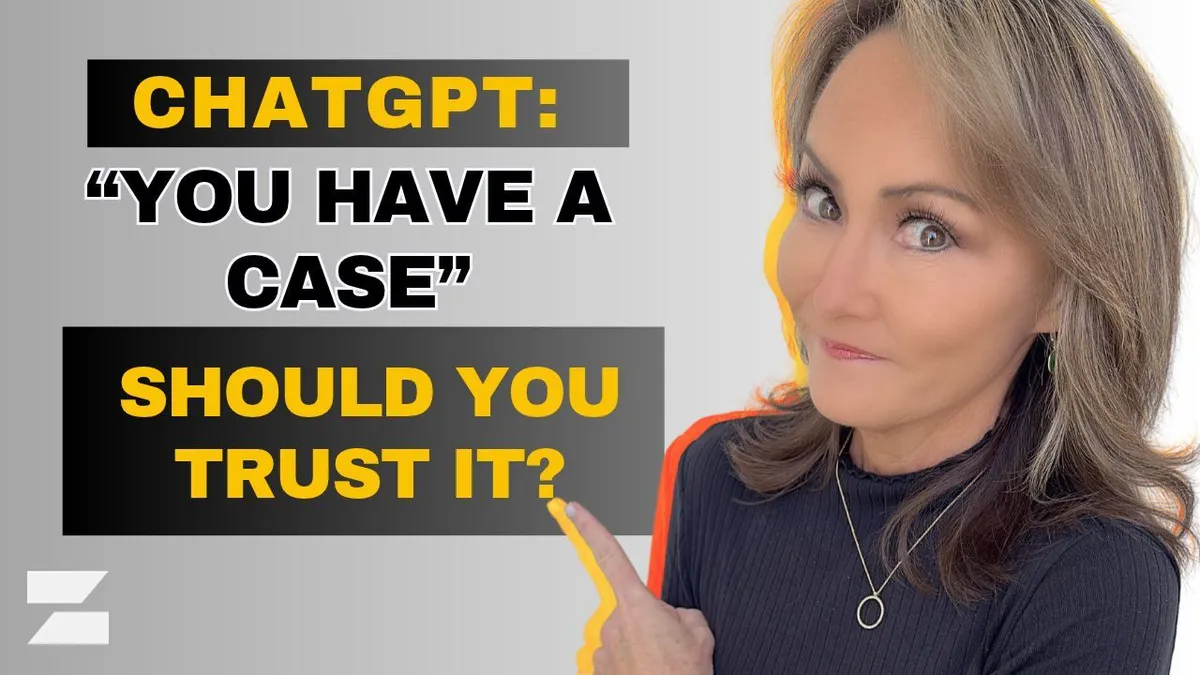
ChatGPT Says You Have a Legal Case. Should You Trust It?
If you have ever been involved in a legal dispute, you know how overwhelming it can feel. Maybe someone broke a promise, took your money, violated an agreement, or caused you serious harm. You want answers. You want to understand your rights, and you want to know whether the law can help you get the outcome you deserve.
So you turn to ChatGPT or another artificial intelligence tool. You explain what happened, describe the other person's behavior, and ask a simple question: Do I have a case?
The answer may sound incredibly convincing. The chatbot might identify potential legal claims, explain possible damages, and give you a detailed argument for why you could win. For a moment, you may finally feel heard. You may even believe you have found the confirmation you have been looking for.
But there is an important distinction you need to understand: an AI-generated legal explanation is not the same thing as a professional evaluation of your case.
As a trial attorney and someone who has spent years working with high-conflict legal situations, I understand why people turn to AI. Legal disputes are expensive, complicated, and emotionally exhausting. People want information before they spend money on an attorney, and AI can be a useful starting point.
However, relying too heavily on what a chatbot tells you can create serious problems. In some situations, it can even weaken your position before your case has properly begun.
I recently worked with a client who showed me a document he had prepared with the help of ChatGPT. He intended to use it in court, and the filing was such a mess that I initially wondered whether an attorney had drafted it. When I learned how it had been created, I realized how easily AI-generated legal material can go wrong. The filing had created problems significant enough that another attorney was reluctant to take on the case.
That experience illustrates why you need to be careful. AI can generate language that looks professional without producing an argument that is legally sound. A document can be polished, detailed, and confident while still failing to address the issues that actually matter to a judge.
If ChatGPT says you have a legal case, there are five important questions you should ask before acting on that answer.
Why ChatGPT Might Tell You What You Want to Hear
Imagine you have paid a contractor $15,000, but the work has not been completed. You are frustrated, you believe you have been treated unfairly, and you want to know whether you can sue.
You explain the situation to ChatGPT. The response identifies possible breach of contract or fraud claims and describes the damages you might pursue. It sounds logical, and it may even resemble the argument you had already been considering.
But what if there was an agreement to extend the completion date? What if some of the work was completed? What if the contract contained an arbitration clause? What if you sent a message approving a change that affected the schedule?
Those additional facts could significantly change the analysis.
This example does not mean you necessarily have no claim. It means that your situation needs to be examined in context. The legal answer may depend on facts you did not include in your original question, details you did not realize were important, or documents that tell a more complicated story.
A chatbot may build an argument around the information you provide without adequately testing the assumptions behind it. If your description leaves out something important, the answer may be incomplete. If you present your interpretation as an established fact, the response may build on that interpretation.
This is why receiving an answer that validates your position is not the same as having your position independently evaluated.
Before you rely on an AI-generated legal analysis, you need to move beyond the question of whether your story sounds unfair. You need to understand what the law requires, what evidence supports your position, what the other side might argue, and whether the outcome you want is realistically available.
Question One: What Exactly Is the Legal Claim?
One of the biggest mistakes people make is confusing a bad experience with a legally actionable claim.
Someone may have treated you terribly. They may have disappointed you, broken a promise, or behaved in a way that feels dishonest. Those experiences matter, but they do not automatically establish a legal violation.
A legal claim must be connected to a specific legal rule. Depending on the circumstances, that might involve a statute, a contractual obligation, or another recognized legal basis for seeking relief.
Different claims also have different requirements, often called legal elements. These are the facts you must establish to support the particular claim you are making.
Consider a breach of contract claim. Depending on the applicable law and circumstances, the analysis may involve whether an enforceable agreement existed, whether you fulfilled your own obligations or had a legal excuse for not doing so, what the other party failed to do, and what losses resulted.
Simply saying, “They promised me something, and they did not deliver,” may not answer all those questions.
The same principle applies to fraud. A disappointing outcome or an unfulfilled promise does not automatically prove that someone committed fraud. The legal requirements for fraud are different from those for a breach of contract, and the facts must support the claim being asserted.
This is where you need to be especially careful with AI-generated legal advice. A chatbot might suggest several possible claims, but a list of legal labels does not establish that any of those claims can be proven.
The question to ask is: What would I actually have to establish to support this claim under the law that applies to my situation?
Bring that question to a qualified attorney. Ask them to explain the requirements in plain English and help you understand which facts support each one.
If you cannot yet explain what your claim requires, that is not a failure. It simply means you are still researching and organizing the issue. The mistake is treating preliminary research as if it were a completed legal assessment.
Question Two: What Evidence Supports Each Part of Your Claim?
Once you understand the legal claim you may be pursuing, the next question is what evidence supports it.
An AI response might say that someone intentionally misrepresented information, violated an agreement, or caused you financial harm. But what supports those conclusions?
Is there a written agreement? An email? A text message? A financial record? A witness who observed what happened? Or is the conclusion based primarily on your interpretation of another person's intentions?
Your account matters, and your testimony may be important. However, you need to distinguish between what you personally observed, what the available records show, and what you believe those facts mean.
For example, an insulting text message may demonstrate hostility or anger. It does not necessarily establish that the sender owes you $15,000. The message might be relevant to part of the dispute, but it may not prove the central issue you need to establish.
This distinction is particularly important in high-conflict situations, where communication can be emotionally charged and people may interpret every hostile message as proof of wrongdoing. A message can feel significant without answering the legal question that matters most.
Instead of allowing a chatbot's confident explanation to fill in the gaps, create a clear timeline of events. Identify the relevant agreements, communications, payments, and other records. For each important part of your potential claim, ask yourself what supports it and where that information can be found.
Just as importantly, identify what you do not know yet.
Missing information does not automatically mean you have a weak case. It means there are questions that need to be investigated and answered. Making those gaps visible allows you and your attorney to determine what additional information may be needed and whether the evidence is useful under the applicable rules.
A polished legal argument cannot replace evidence. Your goal should not be to generate the most impressive explanation. It should be to understand what you can actually establish.
Question Three: What Would the Other Side Say?
This is one of the most important questions you can ask, and it is also one that people often want to avoid.
When you believe someone has wronged you, it is natural to focus on the facts that support your position. You may want confirmation that you are right and that the other person should be held accountable.
But effective legal strategy requires you to examine the weaknesses in your own argument, not just the strengths.
Imagine you spend months building a claim against a contractor. Then the contractor produces a document showing that you approved a change to the project schedule. Or the contractor argues that you did not fulfill your own obligations. Perhaps there is a different explanation for a payment, or a written agreement that changes how the dispute must be handled.
You do not have to agree with the other side's interpretation. You do need to be prepared for it.
A claim that looks straightforward from your perspective may look different when another person presents additional evidence or challenges your assumptions. If you do not consider those possibilities early, you may be surprised by arguments that could have been anticipated.
AI can help you brainstorm potential counterarguments. You might ask it what assumptions an analysis is making, what facts could change the conclusion, or how the opposing party might challenge your interpretation.
But remember that AI-generated counterarguments are still a starting point. They need to be checked against the actual facts, the relevant law, and your attorney's assessment.
This process is not about undermining yourself or assuming the other person is right. It is about preparing intelligently. The more clearly you understand the strengths and weaknesses of your position, the better equipped you will be to make informed decisions.
In high-conflict disputes, emotional certainty can make it difficult to consider an alternative explanation. Yet the legal process does not simply ask which person feels more wronged. It requires the relevant facts and law to be evaluated.
You need to be willing to look at the parts of the story you would rather not see.
Protect Your Confidential Information When Using AI
There is another important issue to consider when using AI for legal research: privacy.
You may be tempted to upload every document related to your case, including messages with your attorney, court records, financial information, and sensitive personal details. You might assume that because you are using the material to prepare for litigation, it is automatically protected.
You should not make that assumption.
The confidentiality protections that may apply to communications with your attorney are legally specific. Entering attorney communications or sensitive case information into an external AI service can raise questions about privacy, data handling, and whether certain legal protections could be affected. The answer depends on the circumstances, the tool, and the applicable law.
Before uploading confidential material, ask your attorney which tools are appropriate and what information should remain private. Review the platform's privacy and data-handling practices, and avoid entering sensitive information into a service that has not been approved for your intended use.
I founded SLAY AI to provide a dedicated workspace for organizing legal information and preparing for attorney conversations. Its features include tools for organizing supporting documents, identifying potential contradictions or gaps, mapping information to legal elements, and preparing agendas for discussions with counsel. Anyone considering a platform for legal work should still evaluate its privacy protections and suitability for their specific needs.
The larger point is simple: using AI strategically means thinking about both the quality of its output and the security of the information you provide.
Question Four: Can You Pursue the Claim Through the Correct Process and Within the Deadline?
Even if you have a legitimate legal issue, you can still face serious problems if you pursue it through the wrong process or miss a required deadline.
You need to know where the claim belongs, which court or legal system has authority to hear it, whether an arbitration agreement applies, and whether a statute of limitations or another deadline affects your ability to proceed.
These are not minor administrative details. Procedural rules can have significant consequences.
For example, a claim may need to be brought in a particular jurisdiction. A contract may require arbitration rather than a traditional court proceeding. A filing deadline may have already passed, or a specific procedure may be required before you can pursue the relief you want.
A chatbot may not have all the relevant information about your circumstances. It may also misunderstand which jurisdiction's law applies, overlook an important procedural requirement, or provide information that is not current or relevant to your specific situation.
In the video, I discuss a cautionary legal example involving an appeal that was dismissed after serious procedural failures and the use of fictitious case citations. The court also awarded the opposing party $10,000 in connection with the frivolous appeal. The important lesson is not that every use of AI in a legal matter leads to penalties. It is that legal documents must withstand the actual requirements of the legal process, not merely sound persuasive on paper.
You must verify the authorities cited in any legal document, confirm the applicable procedural requirements, and check deadlines with qualified legal help.
Do not assume that a citation is real because it appears in a professionally written response. Do not assume a legal argument is valid because a chatbot presents it confidently. And do not rely on an AI tool as your only source for determining whether a deadline applies to your case.
If you are preparing to file something with a court, have a qualified attorney review it whenever possible. A document that is inaccurate, unsupported, or procedurally defective may undermine your credibility and distract from the issues you actually need to address.
Question Five: What Would Success Actually Look Like?
The final question may be the most important one of all: What result are you actually trying to achieve, and is it realistically available?
People often approach legal disputes with a clear sense of what they believe should happen. They may want their money back, compensation for a loss, an order requiring someone to do something, or an order preventing certain conduct.
But having a potential legal claim does not guarantee that a court can award the precise outcome you want.
You need to understand what type of relief may be available under the applicable law, what you would have to prove to obtain it, and what risks you may face along the way.
When discussing your case with an attorney, ask what a best-case scenario might look like, what a worst-case scenario could involve, and what realistic outcomes fall between those extremes. Ask about the costs, risks, and practical consequences of continuing. You should also think carefully about the point at which pursuing the dispute may no longer make sense for you.
In my work on negotiation strategy, I emphasize the importance of knowing your limits and understanding your walk-away point, sometimes referred to as your choke point. You need to know what outcome you are pursuing, what you are willing to accept, and what you will do if the other side refuses to agree.
These questions help you move beyond the emotional desire to win and toward a clearer strategy.
AI can help you organize the questions you want to ask, but it cannot guarantee what a judge will decide or accurately predict every development in your case. A chatbot's estimate of potential damages or its description of a possible remedy should not be mistaken for a reliable prediction of the outcome.
A good legal strategy is built around the law, the evidence, the available process, and your actual objectives. It should also account for uncertainty.
___________________________________________________________________________
Give pre-loved fashion a new life with Vinted! Buy and sell secondhand clothing, shoes, and accessories, discover unique finds, and refresh your wardrobe while making more sustainable fashion choices. Download the Vinted app today on the App Store or Google Play and start buying and selling!
___________________________________________________________________________
Use AI as a Tool, Not as a Substitute for Legal Judgment
AI can be useful in a legal dispute when you use it thoughtfully. It can help you organize a timeline, summarize information, identify questions for your attorney, and explore issues you may not have considered. It can help you prepare for a meeting and make better use of the time you spend discussing your case with a legal professional.
But AI should not be treated as the final authority on whether you have a case.
Before acting on its advice, determine the specific legal claim, identify the evidence supporting each required element, consider what the opposing party might argue, verify the applicable procedures and deadlines, and establish what a realistic outcome would look like.
Most importantly, do not allow an answer that feels validating to create false confidence. A chatbot does not know everything about your situation simply because you have explained your side of the story. The information it provides must be evaluated, and the assumptions behind its conclusions must be examined.
If ChatGPT or Claude tells you that you have a case, the right response is not necessarily to believe it or dismiss it. The right response is to investigate further, verify the information, and discuss the relevant issues with a qualified attorney.
Your credibility is valuable. Your time and money are valuable. And if you are already navigating a difficult legal dispute, you do not want to weaken your position by relying on a document that looks impressive but cannot stand up to scrutiny.
The goal is not to use AI to confirm what you already believe. The goal is to use available tools to become better informed, ask stronger questions, and make more strategic decisions.
If you want to approach your legal situation with greater clarity, start by asking yourself what success really means to you. Then work with qualified legal counsel to determine what the law allows, what the evidence supports, and what steps make sense for your circumstances.
Because in the legal process, sounding right and being able to prove your case are two very different things.
Always remember: Leverage plus clarity equals freedom.
— Rebecca Zung
The Leverage Lawyer




